Daily driving in an Indian city can feel like a test of patience and precision. One minute you are threading through a narrow residential lane, the next you are hunting for a parking slot barely wider than the car. Add an unexpected pothole, a sharply built speed breaker, scooters squeezing through both sides, and a 45-minute peak-hour traffic jam, and the choice of car suddenly matters a lot. For decades, hatchbacks have ruled urban India because they are compact, easy to park, affordable to run, and forgiving in crowded streets. But compact and sub-compact SUVs have changed the equation with higher ground clearance, a commanding seating position, and stronger road presence. So which body style actually works better for a daily city commute? Let’s compare the two across the factors that matter most on Indian urban roads.
1. Size & Maneuverability: Navigating Narrow Lanes and Tight Parking
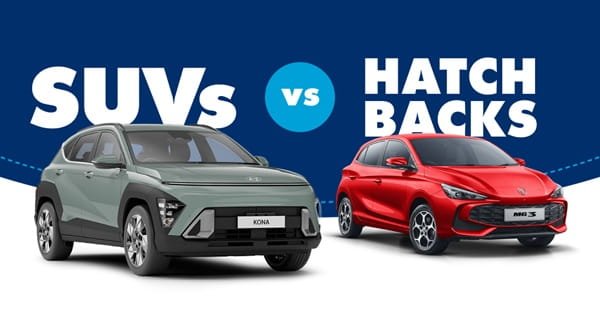
For pure urban agility, a hatchback still sets the benchmark. Its shorter body, compact width, and small turning circle make it easier to move through old-market streets, apartment lanes, school pickup zones, and crowded office districts. Many city-focused hatchbacks have turning radii around 4.5 to 4.8 metres, which helps when taking a quick U-turn on a narrow divider opening or reversing into a basement slot.
Parking is where the difference becomes obvious. In Mumbai, Bengaluru, Delhi-NCR, or Pune, pillars, motorcycles, ramps, and badly parked cars often shrink the usable space. A hatchback can squeeze into shorter parallel-parking gaps and is easier to position in older multi-level car parks.
Compact SUVs are easier to manage than full-size SUVs, but most are still wider than comparable hatchbacks. Wider bodies leave less clearance in narrow lanes, while a larger bonnet and thicker pillars can create bigger close-range blind spots. Tight basement ramps may also demand more steering corrections.
Verdict: Hatchbacks win for sheer urban agility, parking ease, and low-stress maneuvering in crowded neighbourhoods.
2. Ground Clearance: Potholes, Speed Breakers, and Waterlogging
This is where compact SUVs justify their popularity. A typical city-oriented SUV or crossover offers around 180 mm to 205 mm of ground clearance. That extra height is valuable on roads with broken asphalt, deep potholes, uneven patchwork, steep ramps, and speed breakers that appear without warning.
The advantage grows during the monsoon. Waterlogged junctions, damaged road edges, and potholes hidden below muddy water make a low car stressful. A higher SUV body reduces the chance of scraping when the surface suddenly drops.
Hatchbacks usually offer around 160 mm to 170 mm of ground clearance. That is adequate for normal city roads, but a fully loaded hatchback with four or five occupants can sit lower. On unusually tall speed breakers or badly designed ramp transitions, the driver may need to slow right down or take the obstacle at an angle.
Higher ground clearance should not, however, be confused with deep-water capability. A compact SUV can still suffer serious engine or electrical damage if driven into floodwater beyond the manufacturer’s safe limit.
Verdict: SUVs have the clear advantage when your daily route includes potholes, broken inner-ring roads, high speed breakers, or frequent monsoon waterlogging.
3. Fuel Economy & Daily Running Costs in Peak Traffic
Fuel economy matters in stop-and-go traffic because the car burns fuel while covering little distance. Hatchbacks benefit from lower kerb weight and smaller tyres. In mixed urban use, many petrol hatchbacks can return roughly 14-18 km/l, depending on the engine, gearbox, traffic, and driving style.
Petrol compact SUVs in similar conditions often return around 10-14 km/l. Modern turbo-petrols, hybrids, and efficient automatics can narrow the difference, but a heavier body generally needs more energy to accelerate repeatedly in bumper-to-bumper traffic.
The ownership gap continues beyond fuel. Common 14-inch to 16-inch hatchback tyres usually cost less to replace than the wider 16-inch to 18-inch rubber on many compact SUVs. Routine parts can also be cheaper on mass-market hatchbacks.
Insurance premiums are usually lower as well because the purchase price and insured value are typically lower. Over five years of daily city use, these small differences can add up, especially for owners covering 15-30 km every day.
Verdict: Hatchbacks are generally lighter on the wallet in fuel, tyres, insurance, and routine city ownership costs.
4. High Seating Position vs. Compact Cabin Comfort
An SUV’s biggest everyday appeal may be the seating position. Sitting higher gives the driver a better view over small cars and two-wheelers, which can make dense traffic feel easier to read. The upright posture is also comfortable for many drivers who spend long periods crawling through office-hour congestion.
SUVs can also suit elderly passengers because the seat is closer to hip height, reducing the need to bend down. Very tall SUVs may require a climb, so compact SUVs often strike a better balance.
Hatchbacks are not necessarily uncomfortable. Tall-boy models offer excellent ingress and egress, upright seating, and surprisingly generous headroom in a small footprint. Their compact exterior can hide a very usable cabin, especially for four passengers.
For groceries, school bags, laptops, and small suitcases, a hatchback boot is usually enough. An SUV’s taller opening helps with strollers or bulky bags. Bigger outside does not always mean much more usable space, so buyers should compare actual rear-seat comfort and boot shape.
Verdict: SUVs offer better road visibility and flexible space, while well-designed hatchbacks remain extremely practical for small families and daily urban errands.
Summary Comparison
| Metric / Feature | Hatchback | SUV / Compact SUV |
| Turning Radius | Smaller (Extremely Agile) | Larger |
| Parking Ease | High (Fits tight spots) | Moderate |
| Ground Clearance | 160 mm-170 mm | 180 mm-205 mm |
| City Fuel Efficiency | Higher | Moderate |
| Upfront & Maintenance Cost | Budget-Friendly | Typically 15%-30% Higher |
The table shows the basic trade-off clearly. Hatchbacks optimise space, economy, and maneuverability. Compact SUVs trade some of that efficiency for higher clearance, better visibility, and a more flexible body style.
The Final Verdict: Which One Fits Your Daily Commute?
There is no automatic winner, but for a purely urban commute, the hatchback still makes a strong case. It is easier to park, easier to turn in narrow streets, and generally cheaper to run. A compact SUV becomes the better tool when poor road quality is a regular part of the commute.
- Choose a Hatchback if: Your primary drive is a daily city commute under 30 km, you regularly use tight parking spaces, and your main priorities are maximum fuel economy, easy maneuverability, and low maintenance costs.
- Choose an SUV if: Your route includes severe potholes, broken roads, frequent monsoon waterlogging, tall speed breakers, or you strongly prefer a higher seating position and better forward visibility in traffic.
For most buyers who stay within well-paved urban areas, a hatchback remains the smarter city tool. But when Indian city roads become unpredictable, a compact SUV’s extra clearance and commanding driving position can be worth the higher running cost.