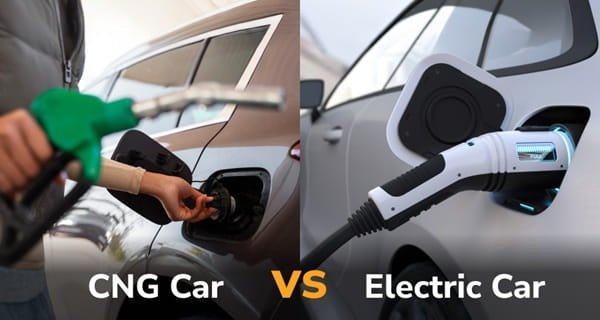
Urban car buying in India is changing quickly. With petrol and diesel costs staying high, traffic congestion worsening, and concerns about local air pollution growing, many buyers are looking beyond conventional fuels. Two alternatives now stand out: factory-fitted CNG and battery-electric vehicles. CNG offers familiar technology, a lower entry cost and quick refuelling once you reach the pump. EVs counter with silent running, instant torque, home charging and zero tailpipe emissions.
The real choice is not simply about which fuel is cheaper. Buyers must weigh upfront price, daily distance, parking and charging access, CNG station queues, boot-space needs, battery ageing and occasional outstation travel. A 20-km commuter may reach a very different conclusion from someone driving 60 km every working day across a metro. Let’s compare…
1. Upfront Price Premium vs. Per-Kilometer Running Cost
CNG usually makes the easier first impression at the showroom. Factory-fitted CNG hatchbacks and compact sedans commonly sit in the roughly ₹8 lakh to ₹12 lakh bracket, depending on model and variant. Entry-level city EVs can now start near the same broad band, while larger or better-equipped electric cars can move beyond ₹15 lakh. Battery-as-a-Service plans may cut the displayed EV purchase price, but the separate per-kilometre battery fee must then be counted.
The equation changes once the car starts covering distance. A fuel-efficient CNG car may cost roughly ₹2.20 to ₹2.80 per kilometre in favourable city conditions, though local gas prices and traffic matter. A home-charged EV can often operate around ₹1.00 to ₹1.50 per kilometre on a normal domestic tariff. Public fast charging, charging losses and heavy air-conditioner use can raise that figure.
State policy can also change the on-road gap. Road-tax or registration concessions and purchase or scrappage-linked EV incentives differ by state and can be revised. Buyers should check the benefit available on the actual registration date rather than assuming an old subsidy still applies.
Verdict: CNG generally wins on initial affordability. An EV becomes financially stronger as daily city mileage rises and most charging is done at home.
2. Charging Convenience vs. CNG Station Queues
For an EV owner with dedicated parking and a home charger, refuelling can almost disappear from the daily routine. Plug in at night and the car can begin the next morning with enough energy for the commute. That is a major advantage for anyone spending long hours in traffic in Delhi-NCR, Mumbai, Bengaluru, Hyderabad or Pune.
The weakness appears when home charging is not possible. Apartment residents with common parking, rented homes, older electrical connections or restrictive housing societies may depend on public chargers. The network is expanding, but availability, parking access and waiting time can still make public charging less predictable. A nominal 40- to 50-minute fast-charge stop can stretch longer when a charger is occupied or unavailable.
CNG has the opposite problem. Refuelling itself is quick, but reaching the nozzle can take time. Busy pumps may develop 15- to 30-minute queues around office hours, taxi-shift changes and weekends. Station pressure and temperature can also affect how much gas is delivered in a fill.
Verdict: EVs are more convenient with reliable home or office charging. CNG is easier for buyers who have no dedicated parking or practical charging setup.
3. Urban Driveability: Instant Torque, Automatic vs. Manual Gears
This is where the electric car feels made for city traffic. An EV delivers torque immediately, has no clutch pedal and normally uses a single-speed reduction gear. In crawling traffic, the driver simply modulates the accelerator and brake. Regenerative braking can also slow the car while recovering some energy, reducing the constant accelerator-brake effort of a long commute.
The cabin is much quieter because there is no combustion engine idling under the bonnet. On flyovers and short overtaking gaps, instant response makes even a modest city EV feel alert.
Factory CNG cars are smoother than older aftermarket conversions, but most still use a petrol engine running on gas. A slight power drop can be noticeable with five occupants, luggage and the air-conditioner running, especially on steep flyovers. Manual gearboxes remain common, although automatic CNG choices are growing. Tata offers CNG-AMT models, while Maruti added automatic S-CNG versions of the Swift, Dzire and Baleno in 2026.
Verdict: EVs provide the easier, quieter and more relaxing city-driving experience, especially in bumper-to-bumper traffic.
4. Practicality, Maintenance, and Battery/Cylinder Compliance
Traditional CNG installations consume a large part of the boot because the cylinder sits across the luggage floor. That can be inconvenient for airport runs, shopping or weekend trips. Newer twin-cylinder designs improve matters by placing smaller cylinders lower in the luggage area, creating much more usable luggage space.
EV packaging varies by model. Cars built around a dedicated or heavily electrified platform can place the battery below the floor, leaving the cabin and boot largely unobstructed. Buyers should still inspect the actual boot because battery packaging differs across vehicles.
Maintenance is another EV strength. There is no engine oil, clutch, exhaust system or conventional engine servicing. Regenerative braking can also reduce brake-pad wear. CNG cars still require normal engine service, ignition components and inspection of the gas system. Indian rules require CNG cylinders to undergo hydrostatic testing every three years.
Battery degradation remains a valid EV concern, but it is normally gradual rather than a sudden failure after a few years. Modern EVs usually carry long high-voltage battery warranties, so buyers should compare both warranty duration and the battery-health threshold covered.
Verdict: EVs usually have lower routine maintenance and better packaging. Twin-cylinder CNG cars improve boot usability, but they still retain engine servicing and cylinder-compliance requirements.
Summary Comparison
The city-use trade-off becomes clearer when the two technologies are placed side by side.
| Metric / City Aspect | CNG Car | Electric Vehicle (EV) |
| Upfront Purchase Price | Affordable (₹8L–₹12L) | ₹8.5L–₹15L+; model dependent |
| Running Cost (Approx.) | ₹2.20–₹2.80 / km | ₹1.00–₹1.50 / km on home charging |
| City Driveability | Manual common; some automatics | Automatic / Instant Torque / Silent |
| Refueling / Charging | Quick fill; queues possible | Overnight at home / fast charging model-dependent |
| Boot Space | Reduced on single-cylinder; better with twin-cylinder | Usually unobstructed; platform-dependent |
| Routine Maintenance | Low, but engine/CNG service required | Very low drivetrain maintenance |
The Final Verdict: Which Fits Your Urban Routine?
For purely urban use, an EV is the stronger product when the charging setup fits your life. Its low home-charging cost, silent automatic drive, instant response and low routine maintenance are especially useful in daily traffic. But that advantage weakens quickly if you cannot charge reliably where you park.
- Buy an EV if: You have dedicated home or office parking with reliable charging, drive around 40 km or more on many days, spend significant time in stop-and-go traffic, prefer an effortless automatic drive, and want zero tailpipe emissions.
- Buy a CNG Car if: You want a lower and more familiar upfront ownership structure, do not have dependable charging at home, make occasional outstation trips where charging planning would be inconvenient, and can tolerate periodic pump queues.
For a city household with a private charger, the EV is increasingly the better daily commuter. For an apartment resident without charging certainty, a factory-fitted CNG car remains one of India’s safest low-running-cost choices.