For a daily commuter in an Indian city, fuel cost is no longer a small line in the monthly budget. A 35-40 km office run through bumper-to-bumper traffic can easily become 1,000-plus kilometres every month, so every rise in petrol price is felt immediately. That is why factory-fitted CNG has moved beyond taxis and commercial fleets into mainstream family cars.
The choice, however, is not as simple as “CNG is cheaper.” A petrol car gives smoother response, quicker refuelling, fewer fuel-station constraints, and full boot space. A CNG car can cut fuel spend dramatically, but it may bring longer pump stops, slightly weaker performance, extra compliance checks, and some loss of luggage space depending on cylinder layout. Modern twin-cylinder systems have reduced that compromise, but not every trade-off. Let’s compare… the factors that matter most in everyday Indian driving.
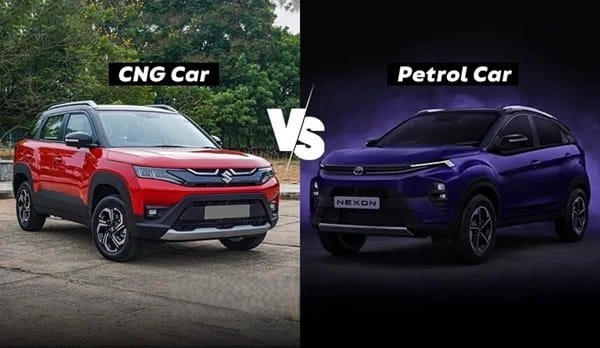
1. Cost per Kilometer: Fuel Efficiency & Monthly Savings
Running cost is the biggest reason to consider CNG. In typical urban use, a petrol hatchback or compact sedan may cost roughly ₹5.50-₹7.00 per kilometre, while an efficient factory-CNG version can work out closer to ₹2.20-₹2.80 per kilometre. Actual figures vary with city fuel prices, traffic, AC use, driving style, engine size, and real-world efficiency.
Take a commuter who drives 40 km a day, or about 1,200 km a month. At ₹6.25/km, petrol costs about ₹7,500 a month. At ₹2.50/km, CNG costs around ₹3,000. That is a saving of roughly ₹4,500 every month, or about ₹54,000 a year.
Factory-CNG variants commonly cost around ₹80,000-₹1,00,000 more than equivalent petrol trims, depending on model and equipment. At the above saving rate, the extra purchase cost can be recovered in roughly 18-22 months. A lower-mileage user will take much longer.
CNG mileage is measured in km/kg, not km/l, so headline mileage figures should not be compared directly with petrol.
Verdict: If your car regularly covers 35-40 km or more per day, CNG wins convincingly on fuel cost.
2. Daily Practicality: Boot Capacity and Fueling Experience
Petrol remains the easiest fuel to live with. Pumps are available almost everywhere, filling takes only a few minutes, and highway travel rarely needs fuel-route planning.
CNG ownership is more location-dependent. Major urban regions have dense networks, but availability can become patchier outside key corridors. At busy stations, the filling itself may be quick while the queue stretches the total stop to 10-25 minutes or more.
Pressure and fill quantity can also vary between stations and times of day. A short fill is not automatically a “summer problem”; compressor load, cascade pressure, gas temperature, and station demand can all affect how much gas goes into the cylinder.
Boot space used to be CNG’s biggest everyday compromise. A traditional single cylinder could occupy most of the luggage bay. New twin-cylinder layouts use two smaller tanks mounted lower, preserving far more usable luggage space. That makes grocery runs, school bags, and cabin suitcases easier to manage, though a petrol car still gives the cleanest, fully unobstructed boot.
Verdict: Petrol offers unmatched convenience. CNG works best when a dependable station falls naturally along your regular route.
3. Engine Power, City Driveability, and Maintenance
A CNG car usually produces less power and torque than the same engine on petrol. A drop of around 10-15% is common in naturally aspirated factory-CNG models, though the exact difference varies.
In normal city traffic, this is rarely a major problem. The gap becomes clearer while overtaking, climbing a flyover with five passengers, joining a fast highway, or accelerating with the AC running. Drivers may need a lower gear and more throttle.
Petrol feels more effortless, with stronger throttle response and less strain under hard acceleration.
A factory-CNG car is not inherently unreliable, but it has extra high-pressure components such as lines, regulators, injectors, valves, and the cylinder. Spark plugs and air filters need to remain healthy, and servicing should follow the carmaker’s schedule.
Under current Indian gas-cylinder rules, automotive CNG cylinders require periodic hydrostatic testing every three years.
Verdict: Petrol wins on effortless driveability and mechanical simplicity; CNG remains practical if you accept slightly lower performance and follow the correct service schedule.
4. Safety Standards, Factory-Fitted Kits, and Resale Dynamics
For a new private car, factory-fitted CNG is usually the easiest route because the fuel system, electronics, and vehicle packaging are engineered together.
Many modern factory systems include features such as seamless fuel switching, leak detection, refuelling micro-switches, and thermal protection. Exact equipment varies by manufacturer, so buyers should check the specific model.
Aftermarket CNG is not automatically unsafe when an approved kit is installed and endorsed through the proper legal process. Risk rises with unapproved components, poor installation, neglected hoses, unauthorised modifications, or incomplete documentation. For most new-car buyers, factory CNG brings fewer integration and warranty concerns.
Resale depends heavily on location. In cities with strong CNG infrastructure, factory-CNG cars can attract high-mileage private users and commercial buyers. In areas with sparse CNG coverage, petrol is often easier to sell.
Verdict: Factory CNG is preferable when fuel savings are the priority. Petrol remains the more universally convenient choice.
Summary Comparison
| Metric / Daily Aspect | Petrol Car | Factory CNG Car |
| Upfront Cost Premium | Base reference | ₹80,000-₹1,00,000 higher |
| Running Cost (Approx.) | ₹5.50-₹7.00/km | ₹2.20-₹2.80/km |
| City Driveability & NVH | Smooth and responsive | Slight power drop, typically ~10-15% |
| Boot Space Usability | 100% unobstructed | Reduced on old layouts; much better with twin-cylinder systems |
| Refueling Time | About 2-3 minutes | Often 10-25 minutes total with queues |
| Ideal Daily Commute | Under about 25 km/day | Over about 35-40 km/day |
The Final Verdict: Which Car Fits Your Daily Routine?
For heavy city use, CNG can make financial sense quickly. For light usage, petrol’s convenience often matters more than the fuel saving.
- Buy a CNG car if: Your daily drive exceeds 35-40 km, a reliable CNG station is on or near your route, you want to reduce monthly fuel spending by roughly 40-50% or more, and you can tolerate occasional queues and slightly reduced performance.
- Buy a petrol car if: Your commute is under about 25 km a day, you value stronger throttle response, full boot space, quick refuelling, simpler ownership, and freedom from CNG-station planning.
For a predictable high-mileage office commute in a CNG-rich city, factory CNG is usually the smarter financial tool. For shorter, irregular driving or frequent intercity travel through areas with limited gas infrastructure, petrol remains the easier all-round choice.