Furniture today is rarely made from solid wood alone. Behind most wardrobes, TV units, office desks, and modular kitchens lies some form of engineered material designed to reduce cost and improve manufacturing efficiency. Two names that often create confusion are particle board and engineered wood.
Many people assume they are completely different materials. In reality, particle board itself is actually a type of engineered wood. But in furniture discussions, homeowners usually compare particle board with higher-grade engineered wood options like MDF or HDF.
At first glance, all of them may look similar once laminate or veneer is applied. But internally, they behave very differently when exposed to weight, moisture, pressure, and long-term use.
The wrong choice can lead to sagging shelves, swollen panels, or furniture that starts weakening within a few years. So before buying ready-made furniture or planning home interiors, it’s important to understand what separates particle board from engineered wood and which one is actually better for your needs.
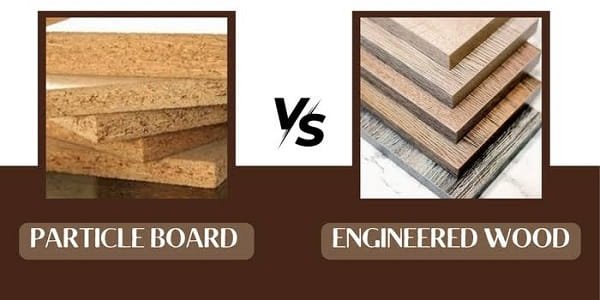
Particle Board vs Engineered Wood: Quick Comparison
| Feature | Particle Board | Engineered Wood |
| Material Composition | Wood chips and particles bonded with resin | Wood fibres, veneers, or particles engineered into boards |
| Strength | Moderate to low | Moderate to high |
| Surface Finish | Smooth but basic | Smoother and more refined |
| Moisture Resistance | Poor to moderate | Better depending on type |
| Durability | Moderate | Better overall durability |
| Weight Capacity | Lower | Higher |
| Cost | Very affordable | Slightly more expensive |
| Lifespan | 5–10 years | 10–20 years |
| Repairability | Difficult | Moderate |
| Termite Resistance | Moderate | Better in premium grades |
| Best For | Budget furniture | Modular interiors and modern furniture |
| Maintenance | Moderate | Lower |
What Is Particle Board?
Particle board is made by compressing wood chips, sawdust, and small wood particles together using resin and adhesives under high pressure.
It is one of the cheapest furniture board materials available and is widely used in:
- Budget wardrobes
- Office furniture
- Study tables
- Ready-made furniture
- Decorative panels
Particle board became popular because it allows manufacturers to produce affordable furniture quickly and efficiently.
What Is Engineered Wood?
Engineered wood is a broad category of manufactured wood products designed to improve consistency and reduce dependence on solid timber.
It includes materials such as:
- MDF (Medium-Density Fibreboard)
- HDF (High-Density Fibreboard)
- Plywood
- Blockboard
- Particle board itself
However, in practical furniture discussions, engineered wood usually refers to higher-quality processed boards that are stronger and smoother than standard particle board.
These materials are commonly used in:
- Modular furniture
- Premium wardrobes
- TV units
- Decorative interiors
- Modern office furniture
Strength and Load Capacity
This is one of the biggest differences.
Particle board is relatively weak compared to most higher-grade engineered wood products. Heavy loads can cause:
- Bending
- Cracking
- Sagging shelves
- Loose screws
Engineered wood products like MDF and plywood generally offer better structural strength and stability.
For furniture expected to handle heavy daily use, engineered wood performs much better.
Winner:
Engineered wood
Moisture Resistance
Particle board absorbs moisture very quickly. Once exposed to water, it can swell permanently and lose strength.
Engineered wood products vary in moisture resistance:
- MDF has moderate resistance
- Waterproof plywood performs very well
- HDF handles moisture better than particle board
In humid Indian conditions, particle board often struggles long term.
Winner:
Engineered wood
Surface Finish and Appearance
Particle board provides a basic smooth surface suitable for laminates and veneers.
However, engineered wood products like MDF offer:
- Better smoothness
- Cleaner painted finishes
- More refined edges
- Better decorative quality
This is why premium modular furniture usually avoids low-grade particle board in visible luxury sections.
Winner:
Engineered wood
Durability and Lifespan
Particle board furniture generally has a shorter lifespan, especially under heavy use or humid conditions.
Good-quality engineered wood products can last much longer because of:
- Better density
- Improved structural stability
- Stronger bonding
Winner:
Engineered wood
Cost Difference
Particle board is extremely affordable and is one of the cheapest furniture materials available.
Engineered wood products cost more because of:
- Better manufacturing quality
- Higher density
- Improved durability
For budget furniture, particle board remains attractive because of its low price.
Winner:
Particle board for affordability
Weight and Handling
Particle board is relatively lightweight and easy to move, though it can chip around edges.
Engineered wood products may be heavier depending on type and density.
Winner:
Particle board slightly ahead for lightweight furniture
Screw Holding and Fastening Strength
Particle board has weaker screw-holding capacity. Screws may loosen over time, especially if furniture is repeatedly assembled and disassembled.
Engineered wood usually provides stronger fastening and better long-term structural reliability.
Winner:
Engineered wood
Which Is Better for Modular Furniture?
For premium modular furniture, engineered wood is generally preferred because it offers:
- Better finish quality
- Higher durability
- Stronger structure
- Longer lifespan
Particle board is more common in low-cost ready-made furniture.
Which Is Better for Kitchens?
Particle board is usually not recommended for kitchens because moisture exposure can quickly damage it.
Moisture-resistant engineered wood or plywood is far more reliable for kitchen cabinets.
Winner:
Engineered wood
Which One Should You Choose?
Choose particle board if:
- You want budget-friendly furniture
- The furniture will face light usage
- You need temporary furniture
- Cost matters more than lifespan
- You are furnishing rental spaces
Choose engineered wood if:
- You want stronger furniture
- You need better durability
- You prefer premium modular interiors
- You need better moisture resistance
- Long-term reliability matters
Final Verdict
Particle board and engineered wood may appear similar from the outside, but they differ significantly in strength, durability, and long-term performance.
Particle board is affordable and useful for low-cost furniture, temporary setups, and light-duty applications. But it struggles with moisture, heavy loads, and long-term wear.
Engineered wood, especially higher-grade options like MDF, HDF, or plywood, offers better structural stability, smoother finishes, and longer lifespan. It is the more reliable choice for modern modular interiors and everyday furniture.
In simple terms:
- Choose particle board for affordability and temporary furniture
- Choose engineered wood for durability and better overall quality
For most homes today, investing slightly more in quality engineered wood usually provides better long-term value than choosing the cheapest particle board option.
FAQs
Q: Which is better, particle board or engineered wood?
A: Engineered wood is generally better for durability, strength, and long-term furniture use.
Q: Is particle board a type of engineered wood?
A: Yes. Particle board itself is one category of engineered wood.
Q: Does particle board get damaged by water?
A: Yes. Particle board absorbs moisture easily and can swell or weaken permanently.
Q: Which lasts longer?
A: Engineered wood products usually last much longer than particle board furniture.
Q: Is particle board good for wardrobes?
A: It can work for budget wardrobes, but higher-grade engineered wood is more durable.
Q: Which is cheaper?
A: Particle board is usually much cheaper than premium engineered wood products.
Q: Which is better for modular kitchens?
A: Engineered wood or plywood is much better for kitchens because of better moisture resistance and durability.