When choosing pipes for a construction, plumbing, or industrial project, one question almost always comes up — welded or seamless? At first glance, a pipe is just a pipe. But the way it’s made has a direct impact on how it performs, how long it lasts, and how much it costs.
Whether you’re working on a high-pressure oil line, a factory pipeline, or a simple water supply system, picking the wrong type can lead to leaks, failures, or unnecessary expenses. Both welded and seamless pipes are widely used across industries, but they are designed for different applications.
If you are confused between welded pipes and seamless pipes, this detailed comparison will help you understand which one is better for your needs.
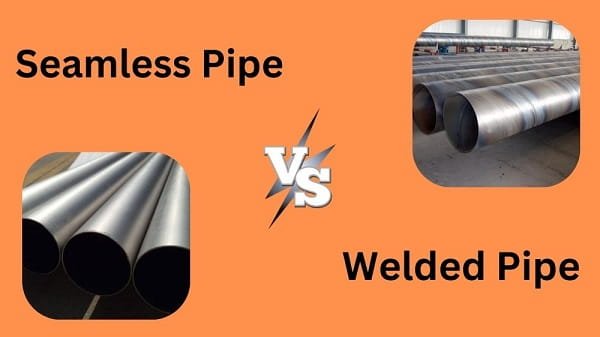
Welded Pipe vs Seamless Pipe: Quick Comparison
| Feature | Welded Pipe | Seamless Pipe |
| Manufacturing Method | Rolled steel welded together | Solid steel billet without welding |
| Strength | Good | Very high |
| Pressure Handling | Moderate to high | Excellent |
| Leak Risk | Slightly higher at weld joint | Lower |
| Surface Finish | Smooth and uniform | Slightly rougher |
| Availability | Easily available | Limited in some sizes |
| Cost | More affordable | Expensive |
| Diameter Options | Wider range available | Limited large-size options |
| Corrosion Resistance | Good | Better under pressure |
| Maintenance | Moderate | Low |
| Best For | Water supply, construction, low-pressure systems | Oil & gas, boilers, high-pressure systems |
| Lifespan | Good | Excellent |
What Is a Welded Pipe?
A welded pipe is made by rolling a steel plate or strip into a cylindrical shape and then welding the edges together.
Different welding methods are used, including:
- Electric Resistance Welding (ERW)
- Spiral welding
- Submerged Arc Welding (SAW)
Welded pipes are widely used because they are:
- Affordable
- Easily available
- Suitable for general-purpose applications
They are commonly used in:
- Plumbing systems
- Construction projects
- Water pipelines
- Structural applications
- Low and medium-pressure systems
What Is a Seamless Pipe?
A seamless pipe is manufactured from a solid steel billet that is heated and pierced to form a hollow tube. Since no welding joint exists, the pipe remains uniform throughout its structure.
Seamless pipes are preferred in industries where:
- High pressure exists
- Extreme temperatures occur
- Structural reliability is critical
They are commonly used in:
- Oil and gas industries
- Power plants
- Chemical plants
- Boilers
- Hydraulic systems
Strength and Pressure Resistance
This is where seamless pipes clearly perform better.
Since seamless pipes do not have a welded joint, they can handle:
- Higher pressure
- Heavy mechanical stress
- Extreme temperatures
Welded pipes are strong too, but the welded seam remains the weakest point of the pipe structure.
For high-pressure industrial systems, seamless pipes are usually the safer choice.
Winner:
Seamless pipe
Leak and Failure Risk
A welded pipe may develop problems at the seam if the welding quality is poor or if the pipe faces extreme stress over time.
Seamless pipes eliminate this risk because there is no weld line.
In critical industries like oil refineries or gas pipelines, reducing leak risk is extremely important.
Winner:
Seamless pipe
Cost Difference
Welded pipes are much cheaper to manufacture, which makes them more affordable for large projects.
Seamless pipes require more complex production methods and higher-quality raw materials, increasing the overall cost.
For budget-sensitive projects, welded pipes are often preferred.
Winner:
Welded pipe for affordability
Availability and Size Range
Welded pipes are easier to manufacture in large diameters and different lengths. This gives them better availability across the market.
Seamless pipes are commonly available in smaller to medium sizes, though large seamless pipes can be expensive and harder to source.
Winner:
Welded pipe
Surface Finish and Uniformity
Welded pipes usually have a more uniform outer surface because they are formed from rolled steel sheets.
Seamless pipes may have slightly less uniformity depending on the manufacturing process.
However, in performance-critical systems, strength matters more than appearance.
Winner:
Welded pipe slightly ahead for finish consistency
Corrosion Resistance
Both pipes can resist corrosion well depending on the material used, such as stainless steel or galvanized steel.
However, welded seams may sometimes become vulnerable to corrosion if manufacturing quality is poor.
Seamless pipes usually perform better under harsh industrial environments and pressure conditions.
Winner:
Seamless pipe
Durability and Lifespan
Seamless pipes generally last longer in demanding applications because of their uniform structure and higher pressure resistance.
Welded pipes also offer good durability for normal construction and plumbing work, especially when high-quality manufacturing is used.
Winner:
Seamless pipe
Which Is Better for Plumbing?
For residential plumbing and water supply systems, welded pipes are often more practical because they are:
- Affordable
- Easily available
- Strong enough for regular use
Seamless pipes are usually unnecessary for basic household water systems unless very high pressure is involved.
Which Is Better for Industrial Use?
For industries involving:
- High pressure
- Steam systems
- Chemicals
- Oil and gas transport
Seamless pipes are generally preferred because of their superior structural integrity.
Which One Should You Choose?
Choose welded pipes if:
- You want lower project cost
- You need large-diameter pipes
- The system operates under normal pressure
- You are working on construction or plumbing projects
- You need easy market availability
Choose seamless pipes if:
- You need maximum strength
- The system handles high pressure
- Safety is critical
- You work in industrial or chemical environments
- Long-term reliability matters most
Final Verdict
Both welded and seamless pipes are excellent in the right applications.
Welded pipes are affordable, widely available, and suitable for most general construction, plumbing, and low-pressure systems. They offer excellent value for money in regular projects.
Seamless pipes, however, are stronger, safer under pressure, and more reliable for demanding industrial applications. Their joint-free structure gives them better resistance to stress, leakage, and failure.
In simple terms:
- Choose welded pipes for affordability and general use
- Choose seamless pipes for high-pressure and critical industrial systems
For most residential and commercial projects, welded pipes are more than sufficient. But when safety and pressure performance are the priority, seamless pipes remain the better option.
FAQs
Q: Which is stronger, welded pipe or seamless pipe?
A: Seamless pipe is generally stronger because it has no welded joint.
Q: Are welded pipes safe?
A: Yes. High-quality welded pipes are safe and widely used in plumbing, construction, and industrial applications.
Q: Why are seamless pipes more expensive?
A: Seamless pipes require a more complex manufacturing process and higher-grade raw materials.
Q: Which pipe is better for high-pressure systems?
A: Seamless pipes are better for high-pressure and high-temperature applications.
Q: Do welded pipes leak easily?
A: Good-quality welded pipes usually perform well, but poor weld quality can increase leak risk over time.
Q: Which pipe lasts longer?
A: Seamless pipes generally offer longer lifespan in demanding industrial conditions.
Q: Are welded pipes good for water supply?
A: Yes. Welded pipes are commonly used for residential and commercial water supply systems.