The cryptocurrency market is much larger than Bitcoin. Although Bitcoin is the first and most widely recognised cryptocurrency, thousands of other digital assets have been created for different purposes. These cryptocurrencies are commonly referred to as altcoins.
The term “altcoin” is generally derived from “alternative coin,” meaning cryptocurrencies that are alternatives to Bitcoin. Some altcoins aim to improve transaction speed, while others are designed for smart contracts, decentralised applications, payments, privacy, governance, or specific blockchain ecosystems.
Understanding what altcoins are and how they work is important for anyone interested in cryptocurrency investing or blockchain technology. However, because altcoins can differ significantly in technology, purpose, supply, and risk, investors should research individual projects carefully rather than treating all altcoins as the same.
What Are Altcoins?
Altcoins are cryptocurrencies other than Bitcoin.
Historically, the term was used mainly for cryptocurrencies launched as alternatives to Bitcoin. Today, it is often used broadly for many crypto assets other than Bitcoin.
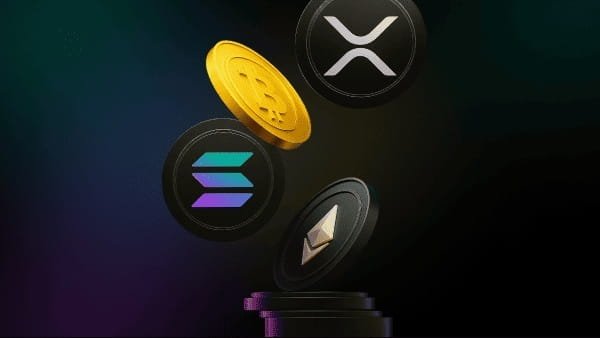
Examples of well-known altcoins and crypto assets include:
- Ethereum (ETH)
- Solana (SOL)
- Cardano (ADA)
- XRP
- Avalanche (AVAX)
- Chainlink (LINK)
- Litecoin (LTC)
- Polkadot (DOT)
These projects are not identical. Each can have its own blockchain architecture, consensus mechanism, token economics, governance model, and purpose.
For example, Ethereum is widely known for smart contracts and decentralised applications, while Litecoin was designed as a cryptocurrency focused on peer-to-peer payments. Other projects focus on decentralised finance, interoperability, blockchain infrastructure, or other specialised applications.
How Do Altcoins Work?
The way an altcoin works depends on the specific project.
However, many altcoins use blockchain technology to record transactions and manage digital assets.
A simplified process works like this:
- A user creates or receives cryptocurrency.
- The user initiates a transaction through a crypto wallet.
- The transaction is broadcast to the relevant blockchain network.
- Network participants verify the transaction.
- A consensus mechanism determines how the transaction is included in the blockchain.
- The transaction is recorded on the distributed ledger.
- The recipient receives the associated blockchain-based asset.
The technical details can vary considerably from one blockchain to another.
Altcoins and Blockchain Technology
Most major altcoins operate on blockchain networks, although the exact architecture differs.
A blockchain is a distributed ledger that records transactions and other types of data. Instead of relying entirely on a single central database, blockchain networks can distribute information among multiple participating computers.
Some altcoins operate on their own independent blockchains, while others are issued as tokens on existing blockchain networks.
For example, an asset can be created using the infrastructure of an established smart-contract blockchain. In that case, the token may rely on the underlying network for transaction processing and security.
This distinction is important because not every crypto asset has its own independent blockchain.
What Is the Difference Between a Coin and a Token?
The terms “coin” and “token” are often used interchangeably in casual cryptocurrency discussions, but they can describe different things.
A coin generally refers to a cryptocurrency that operates on its own native blockchain.
For example, ETH is the native asset of Ethereum, while SOL is the native asset of Solana.
A token, on the other hand, is generally created on top of an existing blockchain.
Tokens can represent different types of digital assets or functions. They may be used for payments within applications, governance, access to services, rewards, or other purposes.
This distinction helps explain why the altcoin market includes projects with very different technical structures.
What Are Altcoins Used For?
Altcoins can have many different uses.
1. Payments
Some cryptocurrencies are designed primarily for transferring value between users.
They may focus on transaction speed, fees, scalability, or payment functionality.
2. Smart Contracts
Some blockchain networks are designed to support smart contracts.
Smart contracts are programs stored and executed on blockchain networks according to predefined rules.
They can support applications such as decentralised exchanges, lending platforms, games, marketplaces, and other blockchain-based services.
3. Decentralised Finance
Some altcoins are closely associated with decentralised finance (DeFi).
DeFi applications can provide services such as trading, lending, borrowing, and liquidity provision using blockchain-based systems.
Tokens associated with these ecosystems may be used for governance, rewards, collateral, or other functions.
4. Governance
Some projects give token holders governance-related rights.
Depending on the project, token holders may be able to vote on proposals involving protocol upgrades, treasury management, or other ecosystem decisions.
However, governance systems differ significantly between projects.
5. Blockchain Infrastructure
Some altcoins are designed to support blockchain infrastructure rather than functioning primarily as payment currencies.
They may focus on areas such as interoperability, data services, scaling, decentralised storage, or network security.
How Are Altcoins Created?
Altcoins can be created in different ways.
A project can develop a completely new blockchain with its own protocol and native cryptocurrency. Alternatively, developers can modify an existing blockchain design or create a token using an established blockchain platform.
The process may involve:
- Designing the blockchain or token
- Developing the underlying software or smart contract
- Establishing token supply rules
- Creating a consensus or validation mechanism
- Conducting testing and security reviews
- Launching the network or token
- Building an ecosystem around the project
Some projects also distribute tokens through methods such as public sales, airdrops, mining, staking, ecosystem rewards, or other mechanisms.
The exact process varies greatly from one project to another.
What Is the Role of Consensus Mechanisms?
Blockchain networks need a way for participants to agree on valid transactions and the state of the ledger.
This is called a consensus mechanism.
Two well-known approaches are Proof of Work and Proof of Stake.
1. Proof of Work
In Proof-of-Work networks, miners use computing power to compete to produce valid blocks. Bitcoin uses Proof of Work, and some other cryptocurrencies use similar mechanisms.
2. Proof of Stake
In Proof-of-Stake networks, validators generally stake cryptocurrency and participate in transaction validation and block production according to the network’s rules.
Different altcoins can use different consensus systems or variations of these approaches.
The consensus mechanism can influence factors such as network security, transaction processing, decentralisation, energy requirements, and participation.
What Is Altcoin Market Capitalisation?
Market capitalisation is one of the commonly used metrics for comparing cryptocurrencies.
It is generally calculated by multiplying the cryptocurrency’s circulating supply by its current market price.
For example:
Market Capitalisation = Circulating Supply × Current Price
Market capitalisation can provide a useful indication of the relative size of a cryptocurrency, but it does not automatically indicate whether a project is fundamentally strong or a good investment.
Investors should also consider technology, adoption, token economics, development activity, competition, liquidity, regulation, and security.
Why Do Altcoin Prices Change?
Altcoin prices can be highly volatile.
Several factors can influence their prices, including:
- Market demand
- Bitcoin’s price movements
- Investor sentiment
- Project adoption
- Technology developments
- Exchange listings and delistings
- Token supply changes
- Regulatory announcements
- Partnerships
- Network activity
- Broader economic conditions
Altcoins can sometimes experience much larger price movements than established cryptocurrencies.
This can create opportunities for traders but also increases the possibility of significant losses.
Advantages of Altcoins
Altcoins can offer several potential benefits.
1. Innovation
Different projects can experiment with new blockchain technologies and applications.
2. Multiple Use Cases
Altcoins can support payments, smart contracts, DeFi, gaming, governance, infrastructure, and other applications.
3. Diversification
Some investors consider exposure to different crypto assets as one form of portfolio diversification, although this does not eliminate cryptocurrency market risk.
4. Technological Development
Competition among blockchain projects can encourage improvements in scalability, transaction processing, interoperability, and application development.
5. Risks of Investing in Altcoins
Altcoins can carry significant risks.
6. High Volatility
Prices can rise or fall rapidly, sometimes by large percentages in a short period.
7. Project Failure
A cryptocurrency project may fail to achieve adoption or may stop development.
8. Security Risks
Smart-contract vulnerabilities, blockchain attacks, compromised wallets, and other technical problems can cause losses.
9. Liquidity Risk
Some smaller altcoins may have limited trading volume, making it difficult to buy or sell large amounts without affecting the price.
10. Regulatory Risk
Cryptocurrency regulations differ across countries and can change over time.
11. Scams and Fraud
The large number of cryptocurrency projects has also created opportunities for fraudulent schemes, fake tokens, pump-and-dump activity, and misleading investment promotions.
Investors should therefore avoid making decisions solely because a token has a low price or has recently experienced a large price increase.
Altcoins vs Bitcoin
| Feature | Bitcoin | Altcoins |
| Launch | 2009 | Developed after Bitcoin |
| Main purpose | Peer-to-peer digital money/store-of-value use cases | Varies by project |
| Blockchain | Bitcoin blockchain | May use independent or existing blockchains |
| Consensus | Proof of Work | Varies |
| Supply | Maximum supply of 21 million BTC | Depends on the project |
| Use cases | Payments, monetary asset | Payments, smart contracts, DeFi, gaming, infrastructure and more |
| Risk | High | Often varies widely and can be very high |
The term “altcoin” covers a very broad range of projects, so comparing every altcoin directly with Bitcoin is not always meaningful.
How Should Beginners Research Altcoins?
Before buying an altcoin, beginners should research the project rather than focusing only on its price.
Important questions include:
- What problem does the project solve?
- What is the purpose of its token?
- Does it have a working product?
- Who is developing the project?
- How active is development?
- How many tokens are in circulation?
- What is the maximum or expected supply?
- How are new tokens distributed?
- Is the blockchain secure?
- How liquid is the cryptocurrency?
- What competitors exist?
- What are the project’s regulatory and technical risks?
Reading the project’s official documentation and understanding its tokenomics can provide more useful information than relying solely on social-media predictions.
Conclusion
Altcoins are cryptocurrencies other than Bitcoin and represent a broad part of the cryptocurrency ecosystem. They can serve many different purposes, including payments, smart contracts, decentralised finance, governance, blockchain infrastructure, gaming, and digital applications.
Altcoins work through blockchain networks, cryptography, wallets, and consensus mechanisms. However, the exact technology and purpose can differ substantially from one project to another.
Some altcoins have developed large ecosystems and real-world use cases, while others may have limited adoption or high levels of risk. Therefore, the word “altcoin” should not be treated as a guarantee of quality, utility, or investment potential.
For investors, the most important lesson is to research the individual project rather than judging an altcoin only by its price, popularity, or market hype. Cryptocurrency markets are highly volatile, and investors can lose part or all of their investment. Understanding the technology, tokenomics, use case, development activity, and risks can help users make more informed decisions.