Bitcoin mining is one of the most important processes in the Bitcoin network. It helps confirm transactions, maintain the blockchain, secure the network, and introduce new bitcoins into circulation according to Bitcoin’s protocol.
Unlike traditional currencies, Bitcoin is not issued by a central bank. Instead, its network uses a decentralised system called Proof of Work (PoW). Bitcoin miners use specialised computers and large amounts of computing power to compete for the right to add new blocks of transactions to the blockchain.
But what exactly happens when Bitcoin is mined? Why do miners need powerful machines? How are new bitcoins created? And why does Bitcoin mining require so much electricity?
Let’s understand how Bitcoin mining works step by step.
What Is Bitcoin Mining?
Bitcoin mining is the process of using computing power to help process and secure Bitcoin transactions and add new blocks to the Bitcoin blockchain.
Bitcoin uses a decentralised network, meaning there is no central bank or single company responsible for maintaining the complete transaction history.
Instead, miners and other network participants work according to Bitcoin’s protocol.
Miners collect valid transactions into blocks and compete to find a valid solution to a cryptographic problem. The miner that successfully finds a valid solution can propose its block to the network.
If the block is accepted according to Bitcoin’s consensus rules, it becomes part of the blockchain.
In return for participating in this process, a successful miner can receive a block subsidy (newly issued bitcoin) and transaction fees from transactions included in the block.
Why Does Bitcoin Need Mining?
Mining performs several important functions.
1. Transaction Confirmation
Mining helps organise transactions into blocks and adds them to the blockchain.
2. Network Security
Proof of Work makes it costly to rewrite Bitcoin’s transaction history.
3. Decentralisation
Mining allows independent participants around the world to contribute computing resources to the network.
4. New Bitcoin Issuance
The Bitcoin protocol provides a block subsidy to successful miners, introducing new bitcoins into circulation according to predetermined rules.
Therefore, mining is not simply a method of “creating Bitcoin.” It is a fundamental part of how Bitcoin’s decentralised network operates.
How Does Bitcoin Mining Work Step by Step?
The mining process can be explained through several stages.
Step 1: Bitcoin Transactions Are Broadcast
When someone sends Bitcoin, the transaction is broadcast to the Bitcoin network.
Network participants verify whether the transaction follows Bitcoin’s rules.
For example, the network checks whether the transaction has valid signatures and whether the inputs being spent are available and have not already been spent.
Valid transactions can enter the pool of unconfirmed transactions from which miners construct candidate blocks.
Step 2: Miners Select Transactions
A miner creates a candidate block by selecting transactions from the available pool.
The miner generally considers transaction fees as one factor when selecting transactions.
The candidate block contains transaction data along with other information required by the Bitcoin protocol.
Step 3: The Miner Builds a Block Header
A Bitcoin block contains a block header and transaction information.
The block header includes important information such as:
- Version information
- Reference to the previous block
- Merkle root representing the transactions
- Timestamp
- Difficulty target
- Nonce
The reference to the previous block helps connect the new block to Bitcoin’s existing blockchain.
Step 4: Miners Perform Proof of Work
This is the computationally intensive part of Bitcoin mining.
Miners repeatedly change values such as the nonce and calculate the cryptographic hash of the block header.
The goal is to find a hash that satisfies the network’s current difficulty requirement.
The hash function used by Bitcoin is SHA-256, applied as part of Bitcoin’s hashing process.
The important point is that miners cannot easily predict which nonce will produce a valid result. They must perform a huge number of calculations.
This is why specialised mining hardware is required.
Step 5: A Miner Finds a Valid Block
Eventually, one miner finds a block header that satisfies the current Proof-of-Work target.
The miner broadcasts the proposed block to other Bitcoin network participants.
Other nodes independently verify the block.
They check whether:
- The Proof of Work is valid.
- The transactions follow Bitcoin’s consensus rules.
- The block references the correct previous block.
- The block subsidy is within the permitted amount.
- The block does not contain invalid transactions.
If the block passes these checks, nodes can accept it and extend their view of the blockchain.
Step 6: The Block Becomes Part of the Blockchain
Once accepted by the network, the new block becomes part of the Bitcoin blockchain.
The next block will reference it, creating a chain of blocks.
As additional blocks are added, a transaction generally gains more confirmations, increasing confidence that it will remain part of the accepted chain history.
What Is Proof of Work?
Proof of Work is Bitcoin’s consensus mechanism.
It requires miners to demonstrate that they have performed a significant amount of computational work.
The system is based on competition. Miners around the world perform hash calculations, and the network adjusts the mining difficulty so that blocks are produced at an approximately predictable average rate.
Proof of Work provides an important security property: attempting to rewrite a large portion of the blockchain requires substantial computational resources.
This makes attacks economically and technically difficult, particularly against a large network such as Bitcoin.
What Is Bitcoin Mining Difficulty?
Bitcoin’s mining difficulty determines how difficult it is for miners to find a valid block.
The Bitcoin protocol automatically adjusts the difficulty approximately every 2,016 blocks.
The purpose is to keep the average time between Bitcoin blocks close to approximately 10 minutes, even when the total amount of mining computing power changes.
If more mining power joins the network, the difficulty can increase. If significant mining power leaves, the difficulty can decrease.
This automatic adjustment is one of the important features of Bitcoin’s design.
What Are Bitcoin Miners Rewarded With?
Bitcoin miners can receive two major forms of revenue:
1. Block Subsidy
The block subsidy consists of newly issued bitcoin provided according to Bitcoin’s protocol.
The subsidy decreases over time through an event commonly called the Bitcoin halving.
2. Transaction Fees
Miners can also receive transaction fees associated with transactions included in their blocks.
The combination of the block subsidy and transaction fees forms the miner’s block reward in common usage, although technically the block subsidy and transaction fees are separate components.
As the block subsidy continues to decrease over Bitcoin’s lifetime, transaction fees are expected to become increasingly important to miner economics.
What Is Bitcoin Halving?
A Bitcoin halving reduces the block subsidy paid to miners by approximately half.
Halvings occur after every 210,000 blocks.
The first Bitcoin blocks had a much larger block subsidy than today’s subsidy. Over time, these scheduled reductions have slowed the rate at which new bitcoins enter circulation.
The maximum supply of Bitcoin is defined by its protocol at 21 million BTC.
The halving mechanism is therefore an important part of Bitcoin’s monetary design.
What Hardware Is Used for Bitcoin Mining?
In Bitcoin’s early days, people could mine using ordinary computers.
As competition increased, miners moved to more powerful hardware.
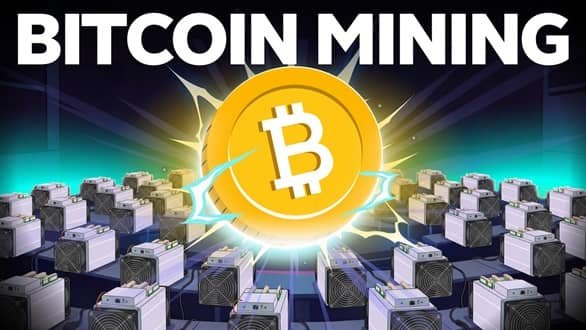
Today, Bitcoin mining is primarily performed using ASICs (Application-Specific Integrated Circuits).
ASIC miners are specialised machines designed specifically for performing the calculations required by Bitcoin’s Proof-of-Work algorithm.
Compared with general-purpose computers, ASICs can perform Bitcoin mining calculations much more efficiently.
However, they consume significant amounts of electricity and generate considerable heat, which means mining operations also require appropriate power infrastructure and cooling.
What Is a Bitcoin Mining Pool?
Mining Bitcoin independently is difficult because the network has enormous total computing power.
To improve the consistency of their earnings, many miners participate in mining pools.
A mining pool combines the computing power of many miners.
When the pool successfully mines a block, the resulting rewards are distributed among participating miners according to the pool’s payout rules and the work they contributed.
Mining pools allow smaller participants to receive more regular payouts instead of waiting for an unlikely solo mining success.
Why Does Bitcoin Mining Use So Much Electricity?
Bitcoin mining requires repeated hash calculations. Large-scale mining operations can therefore consume substantial amounts of electricity.
The energy requirement is closely connected to Bitcoin’s Proof-of-Work security model.
Miners spend money on electricity and hardware to compete for block rewards. This creates an economic cost associated with producing blocks and attempting to attack the network.
Bitcoin’s energy use is a major topic of debate.
Supporters argue that Proof of Work provides strong security and allows a decentralised monetary network to operate without a central authority. Critics highlight electricity consumption and environmental concerns.
The environmental impact also depends on the sources of electricity used by mining operations.
Is Bitcoin Mining Profitable?
Bitcoin mining profitability is not guaranteed.
A miner’s profitability depends on several factors, including:
- Bitcoin price
- Mining difficulty
- Electricity cost
- ASIC efficiency
- Hardware cost
- Cooling expenses
- Pool fees
- Block subsidy
- Transaction fee revenue
- Hardware lifespan
For example, a miner operating with very cheap electricity and efficient equipment may have a different cost structure from a miner paying high electricity rates.
Therefore, simply owning a mining machine does not guarantee profits.
Can Anyone Mine Bitcoin?
Technically, Bitcoin’s network is open to participants who meet the hardware and software requirements.
However, competitive Bitcoin mining has become an industrial-scale activity.
Modern mining requires specialised ASIC hardware, reliable electricity, cooling infrastructure, networking equipment, and technical management.
For individuals, solo mining can be extremely unlikely to produce a block because of the enormous competition across the global mining network.
This is one reason mining pools are widely used.
Bitcoin Mining and Network Security
One of the most important benefits of mining is network security.
To successfully manipulate Bitcoin’s blockchain history, an attacker would need to overcome the Proof-of-Work competition and the economic incentives protecting the network.
The more cumulative work added to the blockchain, the more expensive it becomes to replace historical blocks.
This does not mean Bitcoin is mathematically impossible to attack. Rather, its design makes certain attacks extremely resource-intensive and economically difficult.
Bitcoin Mining vs Traditional Currency Creation
Bitcoin’s monetary system is different from traditional central banking.
| Bitcoin | Traditional Currency |
| New BTC issued according to protocol rules | Currency supply influenced by monetary institutions |
| Decentralised network | Centralised institutional framework |
| Uses Proof of Work | Does not rely on Bitcoin-style mining |
| Maximum supply of 21 million BTC | Supply rules differ by currency |
| Transactions recorded on blockchain | Transactions recorded through financial institutions |
| Miners help secure the network | Banks and payment systems process transactions |
This difference is one of Bitcoin’s defining characteristics.
Conclusion
Bitcoin mining is much more than a process for generating new cryptocurrency. It is a core component of the Bitcoin network’s security and transaction-processing system.
Miners use specialised computers to perform Proof-of-Work calculations, compete to produce valid blocks, and help maintain the blockchain. When a miner successfully produces an accepted block, it can receive the block subsidy and transaction fees according to Bitcoin’s protocol.
The network automatically adjusts mining difficulty to maintain an approximately consistent block-production rate, while the Bitcoin halving mechanism periodically reduces the block subsidy. Together, these features form part of Bitcoin’s decentralised monetary and security system.
However, Bitcoin mining is a highly competitive industry. Modern mining generally requires specialised ASIC hardware, substantial electricity, cooling infrastructure, and careful cost management. Profitability can change significantly based on Bitcoin’s market price, network difficulty, electricity costs, and mining hardware efficiency.
In simple terms, Bitcoin mining uses computing power and Proof of Work to confirm transactions, secure the blockchain, and distribute new bitcoins according to predetermined protocol rules. This system allows Bitcoin to operate without relying on a central bank to maintain its transaction ledger.