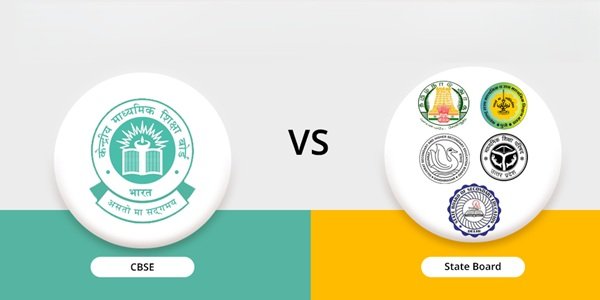
Choosing the right education board is an important decision for students and parents in India. The school board influences the syllabus, examination pattern, teaching methods, language options, and academic preparation of students. Among the popular choices, the Central Board of Secondary Education (CBSE) and State Boards are widely followed across the country.
CBSE follows a national-level curriculum designed to provide a relatively consistent academic structure across its affiliated schools. State Boards, on the other hand, are established by individual state governments or authorised state-level bodies to manage school education according to regional educational requirements. Both systems aim to provide quality education, but they differ in curriculum design, examination methods, language preferences, and administrative structure. Understanding these differences can help parents select a suitable board according to their child’s educational needs and future goals.
What Is CBSE?
The Central Board of Secondary Education (CBSE) is a national-level school education board functioning under the Ministry of Education, Government of India.
It affiliates schools across India and in several other countries. CBSE prescribes curricula, conducts major board examinations, and establishes academic guidelines for its affiliated schools.
Key features of CBSE include:
- A relatively standardised national curriculum.
- Greater emphasis on Mathematics, Science, and core academic subjects.
- Availability of multiple language options.
- Competency-based and application-oriented learning.
- Board examinations for Classes 10 and 12.
- Academic and skill-based subject options.
- A curriculum that provides a convenient foundation for many national-level entrance examinations.
CBSE is often preferred by families who relocate frequently because its affiliated schools are available in different Indian states and cities.
What Is a State Board?
A State Board is an educational authority responsible for school education and examinations within a particular Indian state.
Different states have their own education boards, such as the Maharashtra State Board, Uttar Pradesh Madhyamik Shiksha Parishad, Tamil Nadu State Board, and Karnataka School Examination and Assessment Board.
State Boards generally design their curricula according to regional educational priorities, language requirements, and state-level academic policies.
Key features of State Boards include:
- Curriculum designed according to state education requirements.
- Greater availability of regional language instruction in many schools.
- Focus on state-specific history, geography, and culture.
- Examination systems administered by respective state authorities.
- Subject combinations based on state-level academic regulations.
- School education aligned with applicable state curriculum frameworks.
The exact syllabus, examination structure, and teaching methods vary considerably between states. Therefore, all State Boards should not be considered identical.
CBSE vs State Board: Key Differences
Although both systems provide recognised school education, they have several differences.
| Comparison Factor | CBSE | State Board |
| Administration | National-level board | State-level education authority |
| Curriculum | Relatively standardised nationally | Designed according to state requirements |
| Syllabus | Based largely on national curriculum frameworks | Based on state curriculum frameworks |
| Language | Multiple language options | Regional language options often receive greater emphasis |
| Examinations | CBSE conducts Class 10 and 12 board examinations | Respective state boards conduct their examinations |
| Study material | NCERT textbooks are commonly prescribed | State-prescribed textbooks are commonly used |
| Regional content | Includes national and regional perspectives | Often gives greater attention to state-specific topics |
| School availability | Affiliated schools across India and abroad | Primarily concentrated within the respective state |
| Competitive exam preparation | Provides a convenient foundation for several national entrance exams | May require additional preparation using relevant national-level resources |
Differences in Syllabus and Curriculum
One of the most important differences between CBSE and State Boards is their syllabus structure.
CBSE Syllabus
CBSE generally follows a nationally structured curriculum with considerable emphasis on conceptual understanding, analytical thinking, and application-based learning.
Students study subjects such as Mathematics, Science, Social Science, English, and other language or elective subjects. NCERT textbooks are commonly used in CBSE schools, particularly in core academic subjects.
The curriculum also includes vocational education, physical education, art education, and skill-based learning opportunities.
State Board Syllabus
State Board syllabuses are developed according to the educational requirements and curriculum frameworks of individual states.
For example, students in Maharashtra may study subjects and regional content based on the Maharashtra State Board curriculum, while students in Tamil Nadu follow the curriculum prescribed by the Tamil Nadu education authorities.
State Boards often provide greater emphasis on regional languages, local history, geography, and cultural subjects.
However, the difficulty and depth of the syllabus depend on the particular state board and class.
Differences in Examination Patterns
CBSE and State Boards also differ in their examination systems.
CBSE Examinations
CBSE conducts major board examinations for Classes 10 and 12. Its assessment approach includes written examinations and school-based internal assessments, depending on the subject and class.
CBSE has also introduced examination reforms. For Class 10, it has implemented a two-board-examination system from 2026, providing eligible students with an opportunity to improve performance in selected subjects under the prescribed rules.
State Board Examinations
State Boards conduct their own secondary and higher secondary examinations according to their respective academic calendars and regulations.
The examination pattern may include descriptive questions, objective questions, practical examinations, and internal assessments.
Some State Boards have introduced competency-based questions and assessment reforms, while others may follow different evaluation structures.
Students should check the official examination guidelines of their respective boards for accurate information.
Which Board Is Better for Competitive Examinations?
CBSE is often considered convenient for students preparing for national-level entrance examinations such as JEE, NEET, and CUET because its core subjects and commonly used NCERT textbooks provide a useful foundation for several examination syllabuses.
However, students from State Boards can also perform well in these competitive examinations.
They may need to use additional NCERT textbooks, entrance examination preparation materials, and practice papers to cover the relevant syllabus.
Therefore, choosing CBSE does not guarantee better entrance examination results. Consistent preparation, conceptual clarity, and regular practice matter more than the board alone.
CBSE vs State Board: Recognition and Higher Education Opportunities
Both CBSE and recognised State Boards provide school qualifications that are generally accepted for higher education admissions, subject to the eligibility requirements of the relevant institution and programme.
Students passing Class 10 or Class 12 from either system can apply to universities, colleges, and professional courses if they meet the prescribed conditions.
For example, engineering, medical, management, and other undergraduate programmes may specify minimum marks, compulsory subjects, or entrance examination requirements.
Recognition does not mean that every board has identical admission rules or subject combinations. Students should check the eligibility requirements of their preferred university or professional course before selecting subjects.
Which Board Should Parents Choose?
The decision between CBSE and a State Board should depend on the student’s learning preferences, family circumstances, and future educational plans.
CBSE may be suitable for:
- Students whose families relocate frequently.
- Students planning to prepare for national-level entrance examinations.
- Parents looking for a nationally structured curriculum.
- Students who prefer commonly available NCERT-based learning resources.
A State Board may be suitable for:
- Students who prefer studying in their regional language.
- Families planning to continue education within the same state.
- Students who want greater exposure to regional history and culture.
- Parents seeking schools that follow the state’s prescribed curriculum.
Parents should also compare school quality, teacher experience, infrastructure, fees, transport, and extracurricular activities before making a decision.
Conclusion
CBSE and State Boards both play important roles in India’s school education system. CBSE offers a relatively standardised national curriculum, wider school availability, and a convenient foundation for several national-level entrance examinations. State Boards provide education according to regional requirements, with greater attention to local languages, culture, and state-specific academic priorities.
Neither board is universally better for every student. The right choice depends on educational goals, preferred learning methods, school quality, and future plans. Parents should carefully compare the syllabus, examination structure, language options, and recognition before selecting a school board.
Frequently Asked Questions (FAQs)
Q. What is the main difference between CBSE and State Board?
CBSE follows a national-level curriculum, whereas State Boards design their syllabuses and examination systems according to individual state educational requirements.
Q. Is CBSE better than the State Board for competitive examinations?
CBSE provides a convenient foundation for several national entrance examinations because of its commonly used NCERT-based curriculum. However, State Board students can also succeed with appropriate preparation.
Q. Are State Board certificates recognised across India?
Certificates issued by recognised State Boards are generally accepted for higher education admissions across India, subject to the eligibility conditions of the receiving institution.
Q. Which board is easier: CBSE or State Board?
There is no universal answer. Difficulty depends on the particular State Board, syllabus, subjects, examination pattern, and student’s learning abilities.
Q. Can a student change from State Board to CBSE?
Yes. Students can generally change boards, subject to admission availability, age and class requirements, documentation, and CBSE and school admission regulations.
Q. Which board is better for studying in a regional language?
Many State Boards provide stronger regional-language options and local-language learning environments. However, CBSE also offers several Indian language subjects.
Q. Do CBSE and State Board students have equal opportunities for higher education?
Generally, yes. Students from recognised boards can apply for higher education if they satisfy the required subject combinations, minimum marks, entrance examination criteria, and other admission conditions.