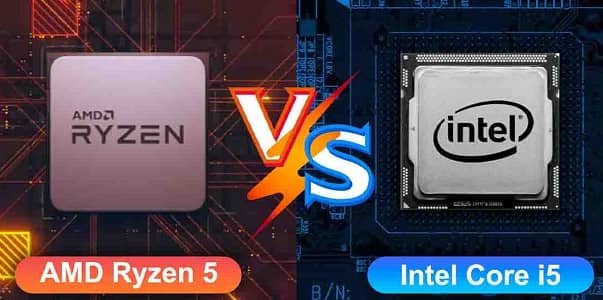
When buying a new laptop or desktop, one comparison appears almost everywhere: AMD Ryzen 5 versus Intel Core i5. Both processors dominate the mid-range market and are found in gaming laptops, office PCs, creator machines, and even budget-friendly systems. On paper, the difference may look simple — Ryzen 5 from AMD, Core i5 from Intel. But once you look deeper into performance, efficiency, gaming, and long-term value, the answer becomes far more complicated.
Over the past few years, AMD and Intel have pushed each other aggressively. Intel still remains a trusted name for raw gaming speed and strong single-core performance, while AMD has earned praise for multitasking power and price-to-performance value. The result is that buyers today have two genuinely strong options.
What Do “Ryzen 5” and “Core i5” Actually Mean?
Both Ryzen 5 and Core i5 are mid-range processor families. They sit between entry-level chips like Ryzen 3 and Core i3, and high-end processors like Ryzen 7 or Core i7.
However, the processor name alone does not tell the full story. Generation matters just as much as the tier itself.
For example:
- Ryzen 5 5600X
- Ryzen 5 7600
- Intel Core i5-12400F
- Intel Core i5-13600K
A newer generation usually brings:
- Better architecture
- Improved efficiency
- Faster clock speeds
- Better integrated graphics
- Support for newer technologies
This is why a modern Ryzen 5 can outperform an older Core i7, and a newer Intel i5 can beat older Ryzen 7 chips in certain workloads.
Which One Is Actually Faster?
Performance depends heavily on what kind of work you do.
Intel Core i5 processors traditionally lead in single-core performance. This helps in:
- Gaming
- Web browsing
- Fast app responsiveness
- Some professional software
Modern Intel i5 processors, especially 13th and 14th generation chips, are extremely powerful for gaming and everyday speed.
AMD Ryzen 5 processors, however, are known for stronger multi-core efficiency. AMD often offers:
- More threads
- Better multitasking
- Excellent sustained performance
For tasks like:
- Video editing
- Streaming
- Programming
- Rendering
- Running multiple apps together
Ryzen 5 processors often feel smoother under heavy workloads.
Verdict: For pure gaming FPS, Intel i5 usually has a slight edge. For multitasking and balanced workloads, Ryzen 5 often performs better overall.
Gaming Performance: Which Is Better?
Gaming performance between Ryzen 5 and Intel i5 has become extremely close in recent years.
Intel still performs exceptionally well in CPU-heavy competitive games such as:
- Valorant
- Counter-Strike
- Fortnite
- Rainbow Six Siege
Higher frame rates and stronger single-core boosts help Intel maintain a small lead in some titles.
But Ryzen 5 processors have improved massively. Paired with a good graphics card, Ryzen systems deliver excellent gaming performance while also handling background tasks smoothly.
Another advantage of Ryzen is stability during:
- Streaming while gaming
- Discord and browser multitasking
- Recording gameplay
For most gamers, the real-world difference is often small unless using a very high-end GPU.
Battery Life and Power Efficiency
Power efficiency has become one of AMD’s strongest areas.
Ryzen 5 processors are generally known for:
- Lower power consumption
- Cooler temperatures
- Better laptop battery life
AMD’s modern architectures are highly efficient, especially in thin laptops.
Intel i5 processors can consume more power during heavy workloads, particularly higher-end unlocked models. This often leads to:
- More heat generation
- Louder cooling fans
- Shorter battery life in some laptops
In desktops, this matters less. But for students or office users carrying laptops daily, Ryzen-powered laptops often feel more power efficient.
Verdict: Ryzen 5 usually wins in efficiency and battery life.
How Good Are the Integrated Graphics?
Not every user buys a dedicated graphics card. Many people rely on integrated graphics for:
- Casual gaming
- Watching videos
- Editing photos
- Office work
AMD Ryzen processors often include stronger integrated graphics, especially Ryzen chips with Radeon graphics.
These integrated GPUs can handle:
- Light gaming
- 1080p media playback
- Basic editing tasks
Intel’s integrated graphics have improved significantly in recent generations, but AMD still often holds the advantage in this area.
For users without a dedicated GPU, Ryzen 5 systems usually offer better graphical performance.
Upgrade Potential and Platform Support
AMD gained major popularity because of long motherboard support.
For years, AMD supported multiple Ryzen generations on the same AM4 platform. This allowed users to upgrade CPUs without changing the motherboard.
Intel changes sockets more frequently. Upgrading to newer Intel processors may require:
- A new motherboard
- Sometimes newer RAM support
AMD systems are often considered more future-friendly for budget builders.
However, Intel motherboards are still widely available and offer strong compatibility with many components.
Price-to-Performance Value
This is where the competition becomes very interesting.
AMD Ryzen 5 processors are usually praised for offering excellent value. Buyers often get:
- Strong multi-core performance
- Better efficiency
- Competitive gaming
- Lower overall platform cost
Intel i5 processors sometimes cost slightly more, especially when paired with premium motherboards and cooling systems.
Still, Intel’s gaming performance and software optimization make the extra cost worthwhile for some users.
| Feature | AMD Ryzen 5 | Intel Core i5 |
| Gaming Performance | Very strong | Slight edge in many games |
| Multitasking | Better multi-core efficiency | Excellent but slightly behind in heavy multitasking |
| Single-Core Speed | Strong | Better overall |
| Battery Efficiency | Better power efficiency | Good but consumes more power under load |
| Integrated Graphics | Stronger Radeon graphics | Improved Intel graphics |
| Heat Generation | Runs cooler | Can run hotter during heavy tasks |
| Power Consumption | Lower | Higher under heavy workloads |
| Upgrade Potential | Better long-term motherboard support | Frequent motherboard changes |
| Content Creation | Excellent for rendering and streaming | Very capable |
| Price-to-Performance | Excellent value | Very good but sometimes costlier |
| Laptop Battery Life | Usually better | Slightly lower in many models |
| Overall Best For | Balanced users, creators, multitasking | Gamers and high single-core workloads |
Final Verdict
Both AMD Ryzen 5 and Intel Core i5 processors are excellent choices today. The difference between them is much smaller than it used to be, and both companies now produce highly capable CPUs for gaming, productivity, and everyday work.
For users focused on gaming performance and maximum responsiveness, Intel Core i5 remains a fantastic option. But for buyers who want better efficiency, multitasking, battery life, and long-term value, Ryzen 5 often comes out ahead.
In the end, the smarter choice depends less on the brand name and more on the exact processor generation, cooling system, laptop design, and your own workload.
Still, if overall value matters most, Ryzen 5 currently offers one of the strongest balances of performance, efficiency, and affordability in the market today.